

Beer and wood

Part 1

Greetings from Asterix

The use of wooden vessels at different stages of the brewing process is not a recent innovation. The first records of wooden vessels made of planks and joined together with wicks or hoops date back to ancient Egypt around the 26th century BC. The ancient Romans, however, attributed the invention of the barrel to the ancient Celts around the 3rd century BC, who at that time called themselves Gauls and inhabited, arguably, all of central and western Europe except the Mediterranean coast. The Celts used casks for their favourite drinks, beer and mead. This is generally considered to be the beginning of the wooden cask era: for the next almost 2000 years, the wooden cask, in various sizes, has been the main means of storage and transport for almost any beverage, as well as a range of other food and non-food products.

It all started when the Romans started growing wine for the garrison in newly conquered Gaul. Soon, wine grown in Gaul became popular in Rome, where it was transported in an innovative container – a wooden barrel. Seeing the advantages of barrels over the clay amphorae that had been used until then, the Romans introduced the barrel as a container for liquids throughout the empire within a few decades.

Barrels of the millennium

Starting in ancient Rome, coopers have been rolling out barrels of all sizes from their workshops for centuries, ranging from a few-litre kegs to take beer with them for a day’s work in the fields, to the 200 000-litre barrel that was built in 1885. was made in France in 2009 for a champagne producer.

The Great London Beer Flood of 1814. October 2007, also started with a dead hoop from a barrel less than 7m high, in which a premium porter was being prepared. The incident resulted in a wave of 600 000 – 1 500 000 litres of beer that destroyed the brewery wall and killed 7 people in the surrounding area.

Bavarian brewers torturing yeast in their ice cellars at low temperatures, the original IPAs the British took to India for their thirsty officers, the Russian imperial porter brewed in England for the Russian imperial court since the time of Peter the Great, any Latvian home-brewed beer, mead or stout – absolutely everything up to 19. by the mid-1500s, spent the entire cooking period in contact with wood. The initial fermentation took place in more or less open wooden vats, after which the beer was transferred for maturation into casks of different sizes and then filled into smaller casks, depending on the needs of the end user.

Happy accidents

Oak is best suited for this purpose: it has a dense wood that allows the barrel to be splinter-proof, it is flexible enough to give the curved shape of the boards, it is strong enough to withstand the stresses of transport, and there was no shortage of oak barrels in its European homeland at the time.

The oak planks need to be exposed to temperature to be bent into the shape required for the barrel. It is likely that experiments with the intensity and duration of the flame began after that, which turned out to cause the tannins in the wood to soften, the sugars to caramelise and the vanillin to open up, making the drink softer on the tongue on contact with the wood. For this reason, barrel ageing is particularly popular for more expensive wines, as well as for cognacs, bourbons, whiskies and rums from different regions.

Unfortunately, this effect does not last forever and the longer the barrel is filled, the less it is able to soften its drink. But this is not a big problem, as other beverage producers may require different characteristics from the cask.

The life of a barrel

In the world of spirits in general, casks are a bit of a walking stick. Take one drink for a few years, then go to another.

For example, the definition of bourbon states that the barrel must be a charred virgin – only corn aged in a new oak barrel that has been charred inside beforehand can be called bourbon. For this reason, bourbon barrels are one of the easiest to access and until recently were mostly used by thrifty Scots, who kept their barley candy in the same bourbon barrels for years or even decades, extracting every last bit of the goodness from the wood.

But the adventures of the cask don’t end there – they are often then used for experimental maturations of rum, tequila, beer or even hot sauces. In this case, the maturation of the beverage in the cask will give it the characteristic flavour and aroma nuances of the previous cask visitor. This is why imperial stouts are often matured in different whisky casks to give the whisky notes that are so characteristic of this style of beer.

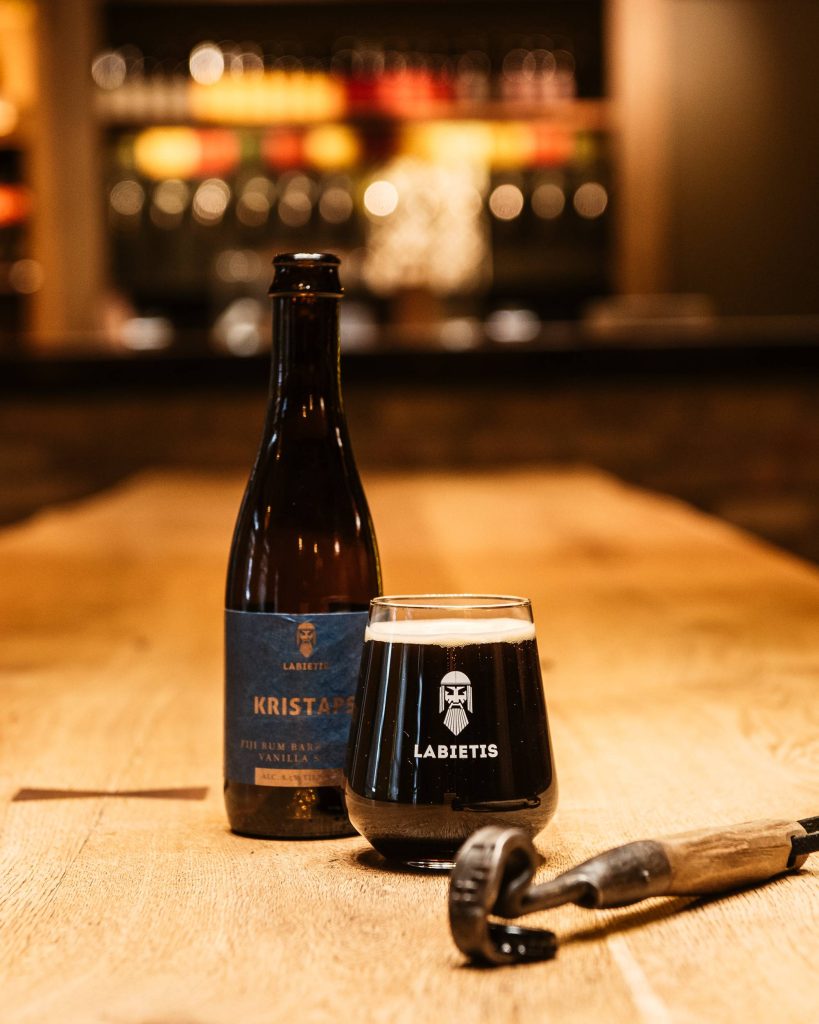
The barrels used for the maturation of Kristaps are quite classic in this respect – it all started in the USA, where barrels made of American oak were burnt and filled with candied corn before being used, which left the barrel as bourbon after 3 or more years. These barrels were then sent to the Fiji Islands, where they were used for an experimental rum made from sugar cane and enriched with tropical herbs before being casked.

After that, the barrels came to us, where they contained our stablemate, the Big Kristaps. To compensate for the vanillin in the bourbon and rum from the barrel, we added vanilla pods for an extra smooth and silky result. Before bottling, beer from several casks was mixed in a metal tank and gently tipped before bottling. This brings us to the second important characteristic of a cask – the ability to let the drink breathe. But more on that next time.
Privacy Overview

This website uses cookies so that we can provide you with the best user experience possible. Cookie information is stored in your browser and performs functions such as recognising you when you return to our website and helping our team to understand which sections of the website you find most interesting and useful.