

BEER AND WOOD
PART 2
Barrel-raised, fed through a spout.
Continuing the theme of beer’s relationship with wooden vessels, the next point to highlight is the ability of a wooden cask to allow the beer it contains to breathe a little. Consequently, the beer has limited but continuous access to oxygen through the wooden walls of the cask. Many traditional brewers in Central Europe and the British Isles are as scared of oxygen as the devil of the cross. Apart from the yeast multiplication phase, when the wort or yeast multiplication tank needs sufficient oxygen, access to additional oxygen during fermentation, bottling and storage is undesirable in almost all ales and lagers. Oxygen unravels the bitterness structure of the hops, gives the malt extractives a cardboardy, muddy taste, and makes the beer greyish in colour.
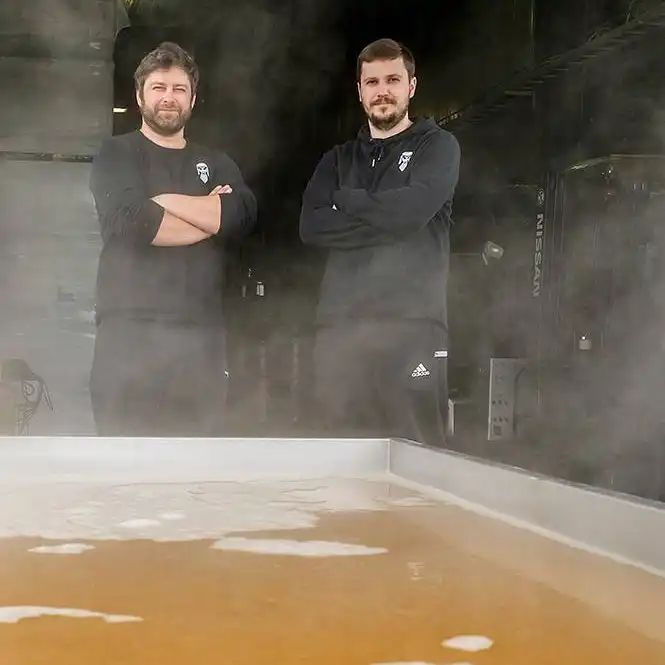
The exception is the ever-clever Belgians, whose brewing tradition is so rich that it includes seemingly archaic principles. Even the wort is wrong for the accidental fermentation or spontaneous fermentation beers: high in protein and starch, brewed with hops that have been specially aerated of all aroma, and instead of being cooled as quickly as possible in a sterile environment before the yeast is added, these beers are left ‘overnight’ in large, open vats, almost in the open air, so that the yeast and bacterial tribes present at that moment can inhabit the wort. These will mostly be genera such as Saccharomyces, Brettanomyces and Lactobacillus.
While in Saccharomyces, apart from the initial stages, the presence of excess oxygen is really not desirable, in Brettanomyces only the presence of a little oxygen can impart some of the characteristic nuances of the spicy clove, a little acetic acid and a range of esters and phenols. The best way to ensure that Brettanomyces and Lactobacillus have unreduced access to oxygen is therefore through the walls of the wooden barrel. Especially since these ales often spend several years in wooden barrels fermenting unhurriedly before reaching the glass.
Consequently, the only brewing industry that did not abandon the use of wooden barrels for fermenting and maturing beer in the mid-19th century were the casual fermenters on the banks of the River Lambic, outside Brussels.
The other thing that makes wooden casks particularly suitable for this style of beer is that they cannot be washed. The wood is porous, so its beer inhabitants – a motley crew of different yeast strains – do not completely leave the barrel with the beer. Arjergard remains in his position, in the pores of the wood, and patiently awaits the arrival of the next saccharine wort, in which the tribes will continue to flourish. If the beer from the cask has an unpleasant taste, the cask is dismantled, the inside shaved to a layer of fresh wood, reassembled and re-fired. Such a cask is called a reconstituted cask or a cask after a major overhaul. The barrel contains fresh vanillin from the heat treatment, and the argyralard of the previous occupants is absent.
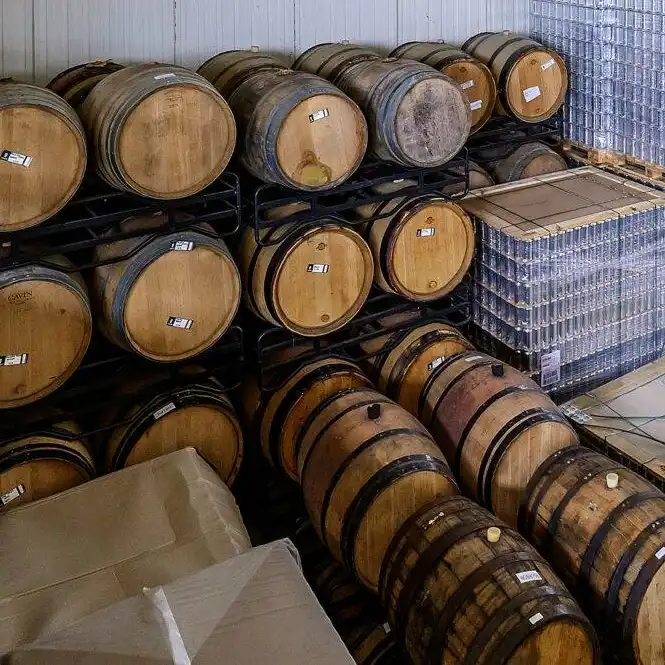
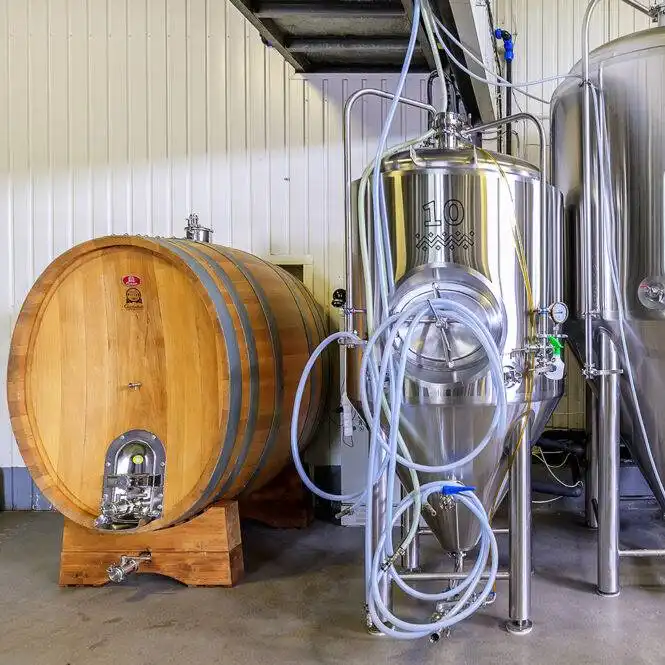
This is exactly the process that our 2000 litre wooden tank, which we bought from an Italian cooper in the spring, went through. As our cask number 13 was ready to start a new life, we paid special attention to the first wort to be introduced into the cask, as well as to the potential cocktail of yeasts and bacteria that would lodge their arjergards in the wooden pores of the cask for decades to come (that’s right, in the beer industry a wooden cask can last 100 years without major repairs if successfully operated), forming the basis for the flavours of the beers coming out of this cask.
Detailed description of the loss of innocence
– We donated one of our most promising casks – a 2-year-old Eimuros random-fermented 225 litre beer with our top-fermented Kilnbeer.
– We brewed a fresh wort, rich in wild yeast delicacies – proteins and starches not converted into sugars – which we left to cool in a log in the open air for the local Eimur yeasts to inhabit. We did this during the growing month of Usiņi, traditionally considered to be the time when nature, including the yeasts, have woken up from hibernation.
– The bucket is made with slightly rancid and uncooked Latgale organic honey, which, as sometimes happens, was harvested a little too early and has a slightly lower sugar concentration, which has allowed the wild flowers to bite a little.
– In the already boiled wort, we threw juniper branches into the log. In our part of the Baltic Sea, juniper has long been associated not only with warding off evil spirits, but also with its widespread use in the brewing process: the juniper branch was used to store yeast between brews, the juniper branches were used as a filter for the mash at the bottom of the wort or giro, and it was also used as an herb.
– In total, we have donated yeasts from 4 different directions to our Kocene: Eimuru 2020, Eimuru 2024, Latgale honey and wild yeasts from junipers. We’ll find out what all of this will yield at the end of the summer, when we might offer a couple of barrels from Kocene to a first-born on his birthday.